

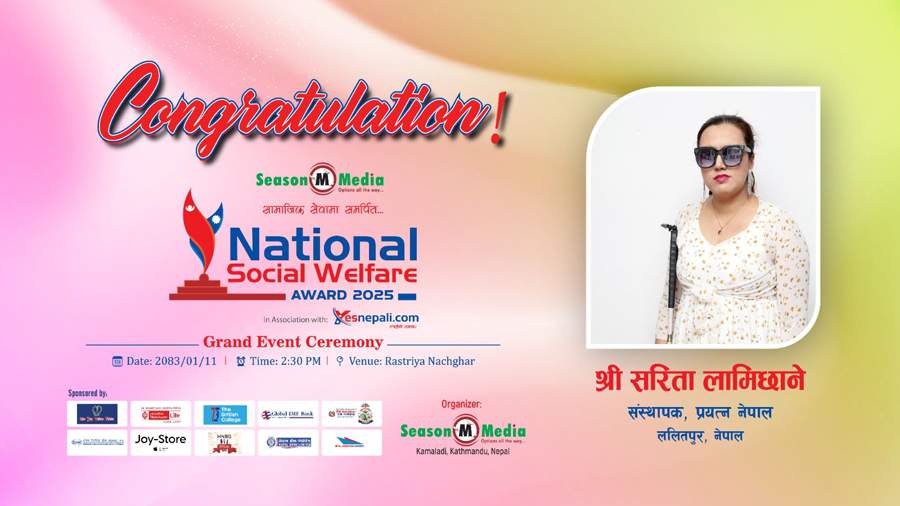
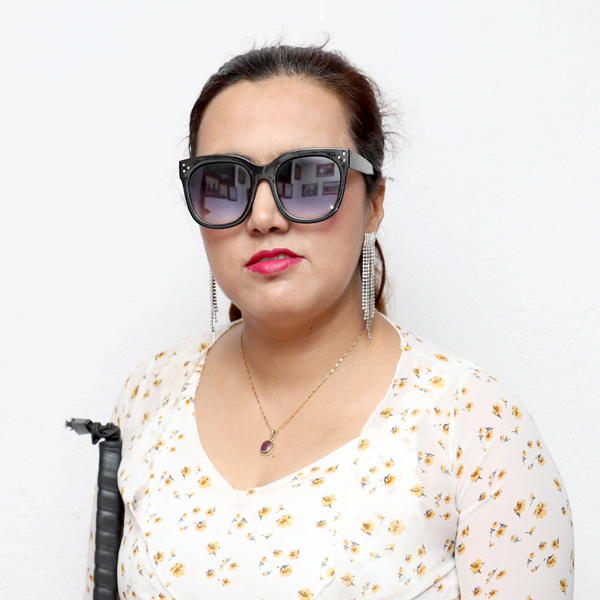
Kathmandu, Sarita Lamichhane was born in a remote village of Nepal and has been blind since birth. While her parents were very supportive and always encouraged her, the society around her was not as understanding. In her community, where education and awareness were limited, many people believed that disability was a curse from a past life. Because of this belief, she often faced stigma and exclusion from others.
At the age of six, Sarita was enrolled in an integrated school amar jyoti Janata secondary luintel Gorkha located approximately a ten-hour walk from her village. Due to the considerable distance, her parents made the difficult decision to have her reside in the school’s hostel. However, as she was the youngest among the visually impaired students, the teachers did not provide her with adequate attention or support. Consequently, much of her early learning, particularly in Braille, came from her father and sister during her visits home, reflecting both her determination and her family’s commitment to her education.
After successfully obtaining her School Leaving Certificate, Sarita moved to Kathmandu to pursue higher education. While living in a girls’ hostel in the city, she encountered other visually impaired women and gained deeper insight into their daily struggles and systemic challenges. This period of her life proved to be transformative, as it sparked her interest in advocating for and supporting visually impaired women. She began volunteering with various organizations and gradually became actively engaged in this cause as a professional pursuit.
During her involvement with the Nepal Disabled Women Association (NDWA), Sarita came across Change Fusion Nepal, a non-governmental organization. From their she has involved youth action fund grantee under the change fusion nepal. And attended self defense training along with 11 visually impaired women. After that, she has conducting a survey on the employment status of visually impaired women. The findings of this survey highlighted significant barriers, including the absence of effective policies, a widespread lack of trust toward blind individuals, and limited opportunities and confidence among visually impaired women. These insights deeply influenced Sarita and strengthened her resolve to advocate for the rights and empowerment of visually impaired women and girls. Motivated by this realization, she applied for leadership training at kanthari.
kanthari is an internationally recognized institute based in South India that provides a seven-month leadership training program for social change makers. At the time of her selection for this program, Sarita was also offered a government job, presenting her with a difficult decision. Many advised her to choose the stability and long-term security of a government position, which included benefits such as a pension in old age. However, she chose to follow her passion and long-term vision, ultimately deciding to attend the seven-month kanthari leadership training program.
Upon successfully completing the kanthari course, Sarita made a firm commitment to empowering visually impaired women and girls in Nepal. Through her experiences, she had come to understand that visually impaired women require not only motivation and confidence but also practical skills to navigate and succeed within a predominantly male-dominated society. With this understanding, she founded Prayatna Nepal after returning from her training.
Established in 2015, Prayatna Nepal is a women-led organization dedicated to empowering blind and visually impaired women and girls to live with dignity, independence, and equal opportunity. Since its inception, the organization has empowered more than 500 women through a range of targeted initiatives designed to address both personal and systemic challenges.
Prayatna Nepal has introduced highly practical and life-changing training programs tailored to the needs of visually impaired women. These programs include cooking and kitchen safety training, daily living skills, orientation and mobility training, signature technique training, self-defense and confidence-building training, and personality development training. Through these comprehensive initiatives, Sarita has not only challenged deeply rooted societal stereotypes but has also contributed to building an enabling ecosystem in which visually impaired women can thrive socially, economically, and digitally.
Today, Sarita Lamichhane’s story is no longer solely about overcoming discrimination and hardship; rather, it represents a powerful example of leadership grounded in lived experience. Her journey illustrates the transformative potential of turning pain into policy, exclusion into empowerment, and silence into a strong and influential voice. As one of Nepal’s most compelling advocates for disability justice and women’s leadership, Sarita’s life serves as a profound reminder that true vision is not defined by sight, but by purpose and determination.
यो खबर पढेर तपाईलाई कस्तो महसुस भयो ?
[WPAC_LIKE_SYSTEM]प्रतिक्रिया
सम्बन्धित खवर